What if reconciliation is not something we achieve, but something we must stay rooted in—together?
In this deeply reflective talk, Dr. Aaron Mills invites our audience to reconsider resurgence and reconciliation through the lens of rooted constitutionalism—an Indigenous way of understanding political community as grounded in land, relationship, and responsibility.
Drawing from Anishinaabe teachings, lived experience, and Indigenous law, Dr. Mills asks us to reflect on how law and governance emerge not from abstract principles, but from our shared rootedness in the living earth.
Together, this conversation will explore questions that challenge many of Canada’s inherited assumptions:
- What happens when political systems are built on understanding land as a living relative, rather than a resource or commodity?
- How does colonialism shape not only laws and institutions, but how we imagine freedom, identity, and belonging?
- What becomes possible when political communities are rooted in relationship rather than domination?
Through story, legal philosophy, and careful reflection, Dr. Mills explores the tension often framed as resurgence versus reconciliation and offers a different possibility—one that holds both in a single breath. Rather than choosing between turning inward or reforming outward, rooted constitutionalism asks how political communities might be renewed by reconciling themselves first to the earth, and then to one another.
This session is an invitation to Canadians—Indigenous and non-Indigenous alike—to listen carefully, reflect deeply, and reconsider how justice, coexistence, and political life might grow when they are grounded in responsibility, reciprocity, and relationship.
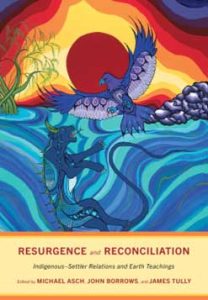
Resurgence and Reconciliation: Indigenous–Settler Relations and Earth Teachings
Edited by Michael Asch, John Borrows and James Tully
Use the code Resurgence2026 to get 20% off your purchase through University of Toronto Press, plus, get free shipping on orders over $40